

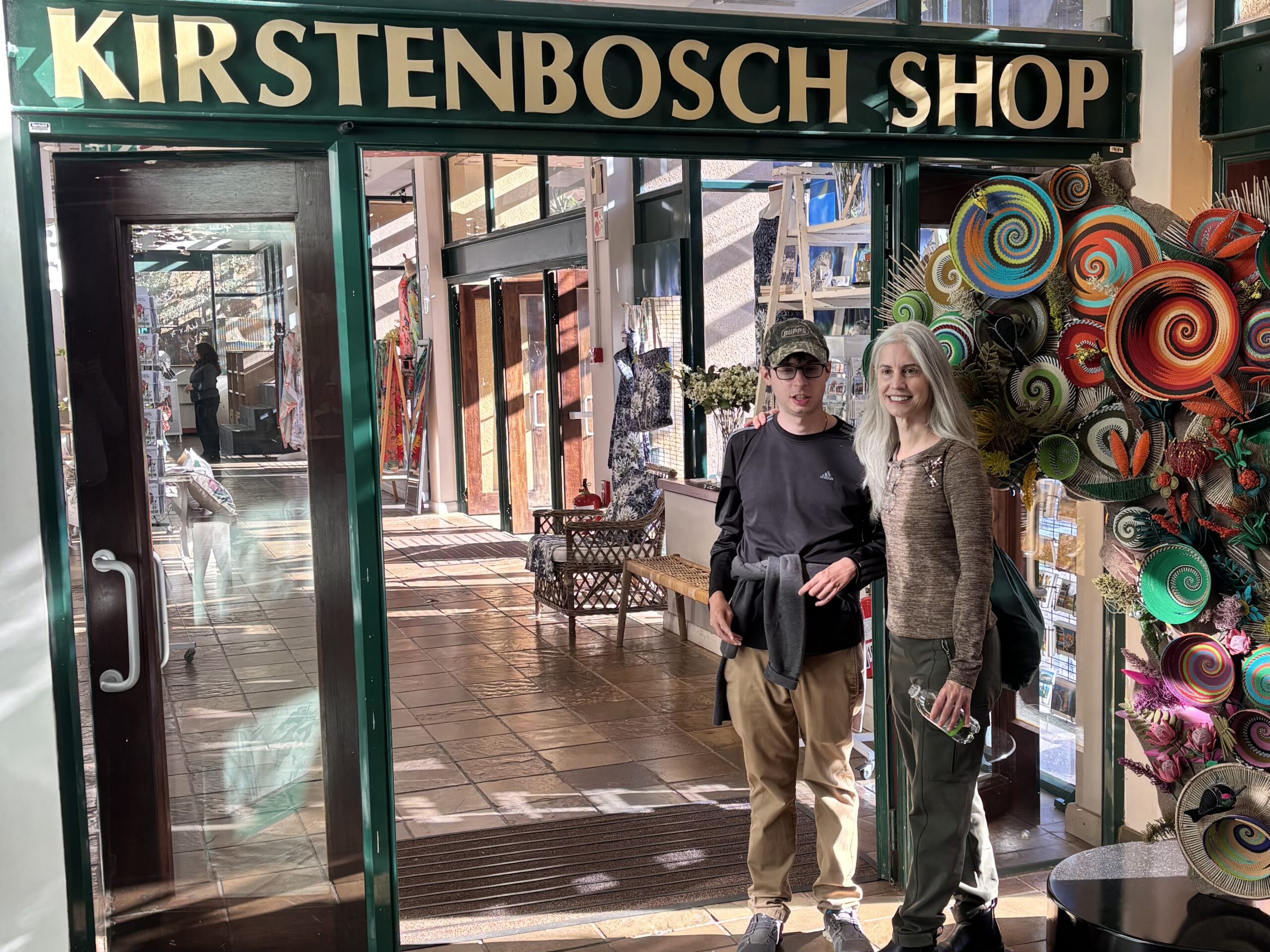
During our recent five-day trip to Cape Town, we got around on foot and by Uber. We rode with a dozen different drivers, three of whom were local and the rest immigrants from various countries, including the UAE, Sri Lanka, Zimbabwe, Nigeria, Pakistan, Ethiopia, and Somalia. My husband, Cesar, who always took the front seat, would greet the driver by name the moment he got in the car, and a brief conversation would ensue.
Our son Diego, who’s thirty-two and autistic, pretty soon caught on to the fact that the drivers hailed from a variety of countries, and, countries being one of his intense areas of interest, he was captivated.
“Where you from?” he would invariably ask, followed by the year he got a book on the given country or some fact about the place. Sometimes, he would also say, innocently, “I don’t wanna go to (insert country). I wanna go to Egypt and Morocco.”
I found Uber drivers in Cape Town to be singularly friendly, talkative, and well-informed. We touched on many topics, including how Rhodesia became Zimbabwe, why we should go to Somaliland if we ever visit Somalia, and what Trump’s actions in Venezuela might mean for my home country.
Even though our rides were never longer than fifteen minutes, sometimes we even entered into personal territory, like how a Somali driver had eight children between the ages of one and fourteen and therefore needed to work, work, work, even on Sundays.
After Cape Town, we rented a car, a Toyota Corolla the color of watered down mustard, and headed east to the wine region of Stellenbosch, and then south along the coast to the town of Hermanus. Listening to some podcast along the way, I learned that Amazon was given the go-ahead commercialize its Zoox, an autonomous vehicle that functions much like an Uber, except sans the driver.
Amazon is now allowed to deploy up to 2,500 of these cars in the city of Las Vegas, another step toward ensuring that what happens in Vegas stays in Vegas. What with the driver out of the picture, it’s one less witness to worry about.
Amazon was indeed spot on in choosing Las Vegas as its first market, but when it comes to branding, well, I mean, a Zoox? I can hear people saying, “I’ll just call a Zoox,” in the same way they call an Uber. But what if the group is too big to fit into just one Zoox? Calling two Zooxes doesn’t sound right, the way calling two Ubers or two taxis does. Perhaps it’s because I’m an early childhood educator, but the name Zoox seems to come straight out of a book by Dr. Seuss, who might have written something like: “So if you want to ride a Zoox, join the dukes that sit on nooks while reading books.”
Because in South Africa the driver sits on the right side of the car and drives on the left side of the road—the opposite of the United States—we agreed that Cesar would be the only one driving. He’s the better driver and would have less difficulty getting a handle on the left-is-right, right-is-left situation
Well, he did great. Not once did he turn into the wrong side of the road. What’s more, he suddenly turned into an accidental gentleman, opening the door for me, if only because the passenger and the driver seats were reversed. But he would see the gesture through, waiting for me to sit before closing my door. Then he’d walk around the car, take the driver’s seat, and reach across with his right arm to the area above his left shoulder for some invisible seat belt.
I know exactly what’ll happen in the future when I hop on a Zoox, which has no steering wheel or pedals. I’ll automatically lift my arms up to grab an invisible wheel at ten and two. I will unnecessarily press my right foot to a phantom pedal when the Zoox needs to speed up or slow down. If Cesar and I are together, he will always head to what used to be the driver’s seat and I to the passenger side. Once in a while, I’ll chastise him for driving too fast. Perhaps I’ll even greet an imaginary driver.
It’s inevitable. The Zooxes and the Waymos will take over our roads sooner than we think, and I, for one, am already starting to mourn their advent. I know I’ll find myself thinking back with great longing to the many exchanges I had with real human drivers of the past.
I’ll remember how a young, handsome driver in Cape Town, one born and bred there, helped me decide whether the alarm company guy on the phone should call the police because there was movement detected in the garage back home in the U.S., and how, when I remarked on the beauty of his home town, he said, “Not where I live. Only where the tourists are,” forcing me to rethink my holiday-induced illusion of prosperity for all.
On a long ride to the airport, I will no longer get to signal that I want to be silent by, for instance, putting on headphones and looking at my phone, or yawning loud, resting back my head and closing my eyes. I’ll also miss the life stories shared, such as the one Oswaldo, who drove us to the airport to catch our flight to Johannesburg, recounted about how he ended up in the United States, a journey that involved a U.S. bound ship filled with cattle running aground off the coast of Uruguay fifty years ago.
There will obviously be an AI in the Zoox that talks to you and can tell stories in whichever accent you choose. But I’ll know the AI will be making it all up, that it doesn’t need to work to support eight children, that it won’t think to emigrate to seek a better life elsewhere, and, of course, that it won’t be grateful for a tip, no matter how big.