

A man in his mid-eighties gets out of the passenger seat of a gray car parked in a handicap space at a Chase Bank. It’s one of his regular outings. Every week, he and his wife get cash by driving a mile and a half to the bank, walking in, and cashing a check with the bank teller, an elegant gray-haired woman named Irene.
How silly to use an ATM or forgo cash altogether — as younger people do nowadays. Why, it would mean missing out on their weekly chats with Irene!
A sloped path leads from the parking space onto the curb, but the man doesn’t take it. Instead, with hands clasped behind his bent back, he shuffles a few feet beyond it to step up to the curb.
And why not? After all, he’s feeling a bit adventurous, and the rise onto the curb is shorter than the seven-and-a-half-inch step height of the 25-step staircase he ascends and descends twice a day at home.
It could also be that he wants to prove Gretchen, his occupational therapist, wrong.
“You need to be using a walker at all times,” she’d said the day before. Well, he’d show Gretchen he doesn’t freakin’ need a walker. Besides, she’s not even seeing him about his walking or lower extremities. She’s there because of his arm.
It’s one thing after another when you get old.
First, a silly bump on a table’s edge results in stitches on his elbow. His skin has turned vellum-paper thin. That, plus the blood thinners, means frequent cuts and bruises. Then the wound gets infected, which leads to oral antibiotics followed by intravenous antibiotics and a few days in hospital.
Why does everyone think they have a right to tell you what you can and can’t do just because you’re old? It’s infuriating.
Yet more infuriating still is that Gretchen was right. As the man steps onto the curb, he fails to lift his foot high enough.
He falls.
Instantly, he knows it’s bad.
Other customers approach him. One alerts Irene. Another calls an ambulance.
The man’s wife, who’d been walking close behind, calls my husband (Cesar) and me.
“Your dad fell, and an ambulance is on its way here,” she says. “We’re at the Chase Bank across from the library. You gotta come over! He’s so hurt, Dani.”
My mom is crying. She will cry on and off — mostly on — for days. My mom has the greatest capacity for crying of anyone I know.
When Cesar and I arrive ten minutes later, the ambulance is already there, and my father is half-seated on the curb, resting his upper body on his left elbow — his good elbow. The medics are asking questions about what just happened and about my father’s health status.
Between all of us, we convey what’s relevant: my father has had both hips replaced, is in good cardiovascular health, and has been on blood thinners for years.
My father quite literally can’t move his right leg. Even though he’s wearing, as per usual, loose-fitting sweatpants, it’s obvious that the leg is splayed at an impossible angle. I know, too, that the pain is excruciating because my father, who has a sky-high pain threshold, winces at the medic’s slightest attempt to shift him onto a stretcher. Anyone else would be hollering.
It takes a minute for me to notice the blood tracing a well-delineated, crooked line across his elbow. I take a closer look as he bends it slightly. The line gapes open like an oyster, revealing off-white matter made of cartilage, bone, tendon.
Compared to the leg injury, however, the cracked elbow, which will merely need to be stitched back up, is an afterthought.
The medics are finally able to slide a stiff, thin slab under my father, which they lift onto the stretcher. I’ll witness various transfer procedures similar to this one over the next few days, usually orchestrated by two staff, one directing the action with commands such as “On three!” and “Ready? Lift!” — just like in a TV hospital drama.
My mom, whose hearing loss is severe and English is weak, keeps asking me the same questions: Do they know your father’s on blood thinners? Why don’t they call his doctor? Where’s the fracture? No answer satisfies her for long.
She cries and cries. The look of fear on her face is that of a young child separated from his mother or lost in the forest. My mom is a person of deep faith who writes the most inspiring and reassuring messages to loved ones facing death and disease, but who can’t accept such misadventures when they strike anyone too close to her, like her own children, siblings, or husband. It’s as if she’s utterly surprised it can happen to them too, as if she didn’t truly trust God’s intentions when it comes to her own family.
I, for one, am not the sympathetic listener she needs in this state, as I’m the opposite. I shut down, show minimal emotion, hardly ever cry, even when my heart is bleeding with psychic pain, which is not the case this time. Somehow, I, a woman of little religious faith, am confident my father will come out of this.
My father spends two weeks at the hospital. He needs to be weaned off the blood thinners over three days to prevent a big bleed during surgery to repair his femur and hip. Pre- and post-surgery, he’s on heavy doses of morphine and other painkillers.
My mother, sisters, and I take turns sleeping on a recliner chair at the hospital. One night while I’m on watch, my father doesn’t fall asleep until after midnight. He keeps asking that I look outside the door to the room to make sure we’re really in a hospital. He insists that there’s a big drop, a void outside the door.
“Do you see the men?” he also tells me. “They’re gray. They’re hitting each other with clubs. Now they’re dancing. They wear clothes like in colonial times.”
“Are they frightening?” I ask.
“Terrifying,” he says.
Another day, he asks if we see the numbers floating in the air, the big jungle all around us. The gray men come back — fighting, then dancing. “It’s like a theater,” he says.
He uses logic to try to convince me that what he’s seeing is real. If he sees it, it’s because it’s there. How can I be sure that what I see is what’s actually there?
I’m ashamed to admit it, but while my mom’s constant need for reassurance annoys me, my father’s insistence that he’s not hallucinating somehow charms me.
The doctors call his mental state hospital-induced delirium. Just like they promise, it’s transient. About five days after the surgery, the jungle and theater vanish, and he’s back in a hospital room.
Free from the distracting visions, my father turns to topics one would expect from an old man taking stock of his life. He talks about his regrets, confesses his sins, repeatedly tells us how much he loves his family, and says he’s ready to meet Papá Dios, our Almighty Father. I, a person who hates mushy emotional conversation, much preferred talking about gray men.
I know my father’s sins. They’re not unforgivable, horrible sins, but I don’t want to talk about or hear them. It’s uncomfortable. But more uncomfortable still is that he goes into confession mode when family friends visit him! Now that is downright embarrassing.
Thankfully, I’m not there for the confession. One of my five sisters is.
It is my father’s fragility that moves me. One day, he’s so melancholic and tired it dawns on me that the little will to live he has left comes from wanting to appease us, to not disappoint us by giving up.
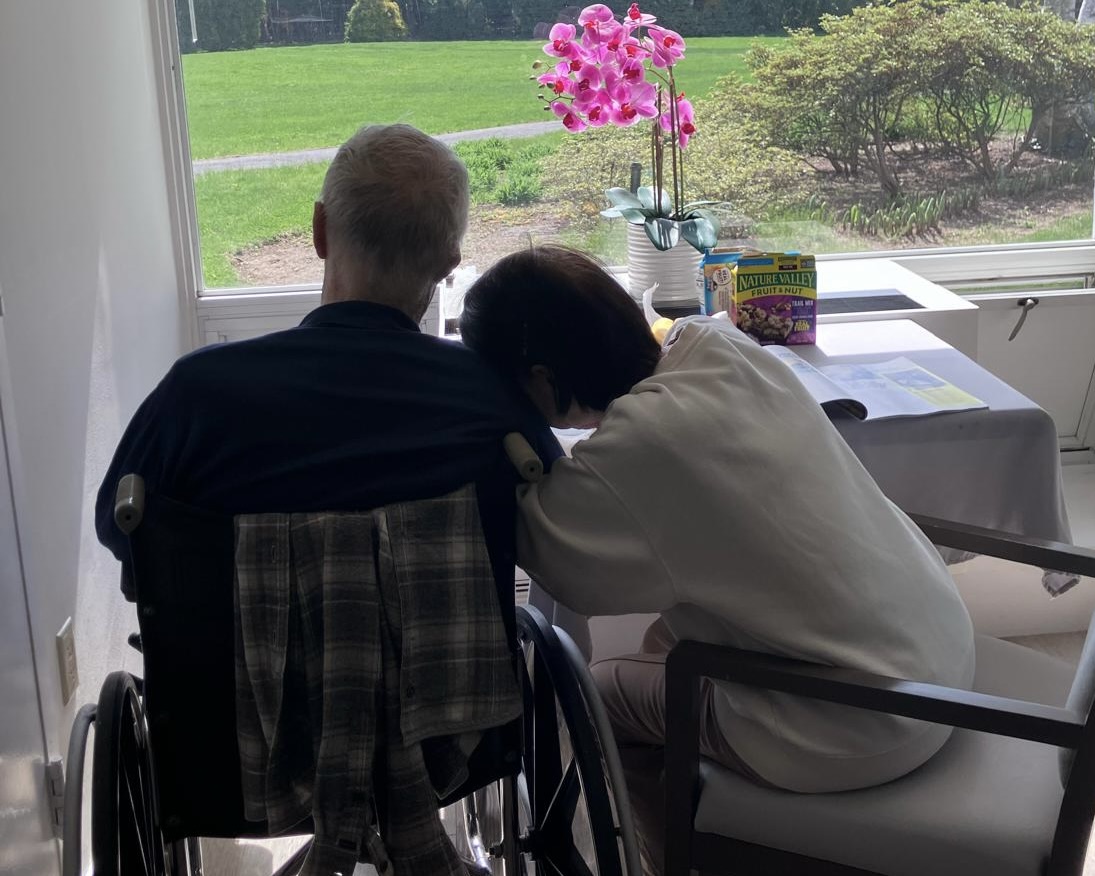
Helping him with the urinal one night, I remember how vulnerability can turn the unpleasant and aggravating into acceptable, even heartwarming and hilarious. I know this already from taking care of my son Diego, who’s 32 and has a developmental disability. His complete trust that his parents will take care of him — from making sure he has good food to eat to attending to his toenail fungus — is disarming.
I like to think there’s mostly pure love in the way my sisters and I talk about our parents behind their backs. We now find nothing more entertaining than discussing — making fun of, really — their shenanigans, like how, at the mention of occupational therapist Gretchen, our mother says, without fail, “Oh, she’s such a sweetheart. She lives in Greenwich. Did you know she lives in Greenwich?” or how, at the hospital, nothing calms my father more than listing the names and dosages of the medications he takes morning and night. He has us recite the list too, turning the exercise into a kind of religious litany.
During his two weeks at rehab after being discharged from the hospital, he has us check, several times daily, that his wallet is in the front right pocket of his sage green sweater, which we must hang on a hanger right against the closet wall. He also has us line up two cups of water, his glasses, and his phone at the far end of the rolling table, just the way his OCD mind needs to see them.
One evening while my father is in rehab, a scene from an episode of The Pitt, the drama series set in a Pittsburgh hospital emergency department, shocks me with perspective. An elderly couple ends up in the ER, where a common dilemma facing older parents and their children plays out: The parents want to continue living at home, while their daughter insists they must move to a supported living community. No argument about health and safety will sway the parents, while no rationale about their aging in place will get through to the daughter.
Then, the father says to the care team, “Everyone who’s old knows what it’s like to be young. No one who’s young knows what it’s like to be old.”
It hits me that I, for one, don’t even seek to understand what it’s like to be as physically old as my parents. Hardly anyone does, I think, except to try to solve or prevent aging, as if being old were a disease or something to be ashamed of, as if many alternatives other than dying young existed.
A very similar version of this essay was first published in Crow’s Feet: Life As We Age